.svg?w=300&h=85)
Two tests you can do yourself. One report your seller should already have.
You bought something labeled "100% mulberry silk." In the photos, it looked soft. In the reviews, it looked luxurious.
Then it arrived. It felt slippery—but not in the way real silk should. It didn't breathe. After one wash, it lost its shape.
So how do you know whether what you bought is genuine silk?
This guide walks you through two tests you can do yourself, and one report your seller should already have. No lab coat required.
At TOWNSSILK, we send a free fabric swatch with every sample request—so you can see, touch, and test the silk before you commit.
Knowing what you're wearing matters.
Knowing what you're wearing matters. It affects how your clothes look, how they feel, and how long they last.
Here's what's at stake:
- You pay premium silk prices for polyester or rayon.
- Fake silk pills, clings, and loses its sheen after one wash.
- Mislabeled silk content can mean allergens, irritants, or poor dye quality.
- Real silk regulates temperature—cool in summer, warm in winter. Fake silk doesn't.
- Genuine silk is tied to fair trade and sustainable supply chains.
In short, knowing your silk protects your wallet, your skin, and your wardrobe.
Test 1: The Burn Test
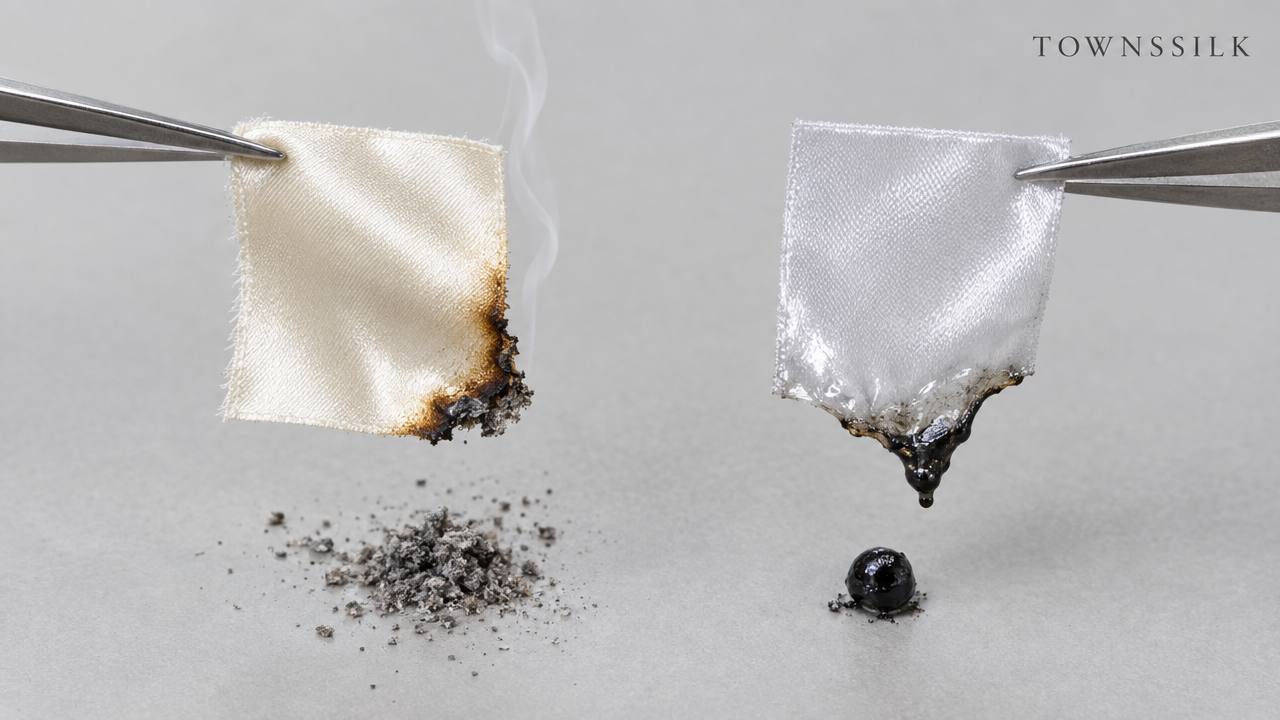
This is the oldest trick in textile testing. It works because real silk is a protein fiber—just like your hair.
Here's how to do it safely:
- Find a hidden spot—inside seam, hem, or the edge of a scarf.
- Snip a tiny strand. You only need a few millimeters.
- Hold it with tweezers over a flame for 2–3 seconds.
- Pull it away and watch what happens next.
Real silk stops burning on its own. It smells like burnt hair. The ash crumbles between your fingers.
Polyester melts, drips, and smells like burning plastic. The residue hardens into a black bead.
Burn test results:
| Fabric | Flame Behavior | Smell | Residue |
|---|---|---|---|
| Real silk | Burns slowly, self-extinguishes | Burnt hair | Crumbles to fine ash |
| Polyester | Melts and drips | Burning plastic | Hard black bead |
| Nylon | Melts, drips | Chemical, acrid | Hard plastic residue |
| Rayon | Burns fast | Burnt paper | Soft gray ash |
Note: the burn test damages the sample. Use it on a hidden piece, and treat it as a quick screen—not a final verdict.
Want to test before you buy? TOWNSSILK sends a free fabric swatch so you can try the burn test yourself.
Test 2: The Bleach Soak Test
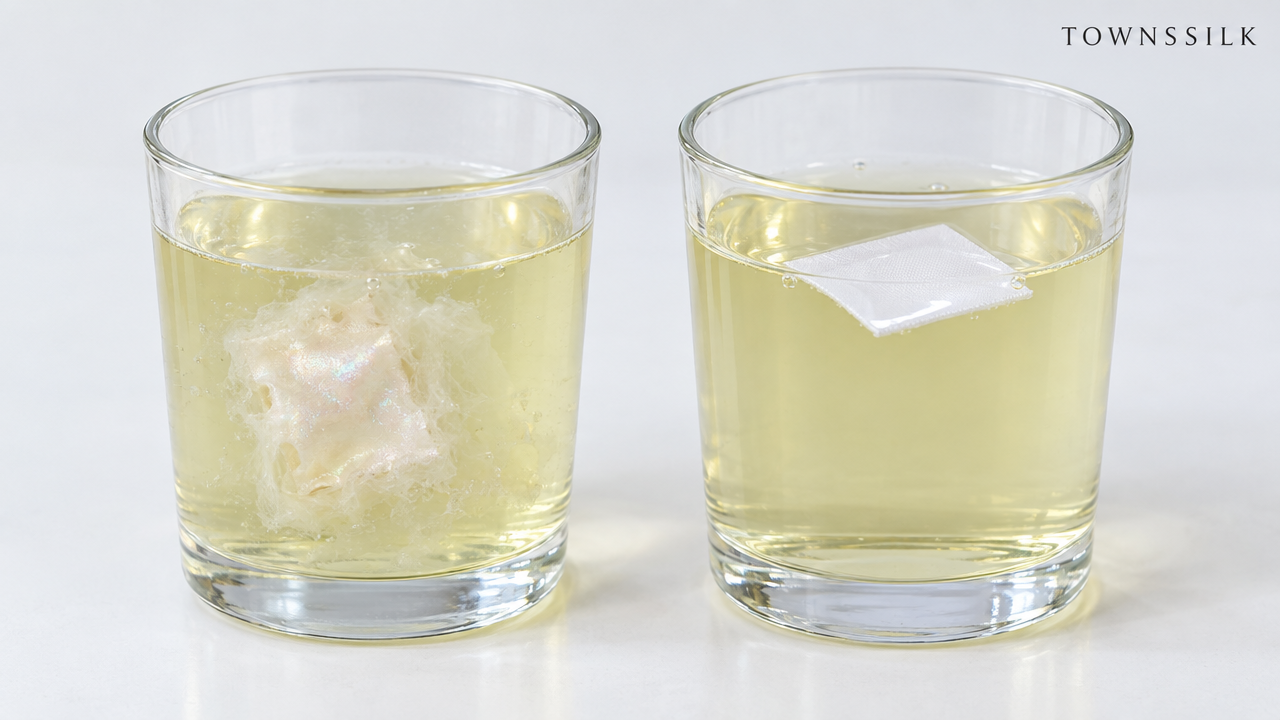
This method uses sodium hypochlorite—the active ingredient in household bleach and in the disinfectant commonly sold in China as "84 disinfectant." Outside China, the same ingredient is sold as liquid chlorine bleach or sodium hypochlorite solution.
The science: silk is a protein fiber, so it dissolves in alkaline sodium hypochlorite. Polyester, nylon, and cotton do not.
What you need:
- Liquid chlorine bleach or sodium hypochlorite solution (5%–10% available chlorine works best)
- A glass cup
- A small strand of fabric or a few loose yarns
- Gloves and a ventilated space
How to do it:
- Pour a small amount of the solution into a glass cup.
- Drop in the fabric strand or yarns.
- Stir gently and wait 5–30 minutes.
- Observe: real silk dissolves into a cloudy gel; polyester and nylon stay intact.
Cautions:
- Concentration varies by product. Weak solutions may not fully dissolve silk—use a fresh, higher-concentration product for a clear result.
- Never mix chlorine bleach with acid (vinegar, toilet cleaner, rust remover). It releases toxic chlorine gas.
- Wear gloves and work in a ventilated area. Sodium hypochlorite is corrosive to skin and lungs.
- This test destroys the sample. Only test a hidden piece.
What the result means:
| Observation | Likely Fiber |
|---|---|
| Dissolves completely into a cloudy gel | Silk (protein fiber) |
| Stays intact, no change | Polyester or nylon |
| Partially dissolves or swells | Silk blend |
This is a fast way to check a seller's claim. It confirms whether silk protein is present—but it doesn't tell you the exact percentage.
Want to test before you buy? TOWNSSILK sends a free fabric swatch so you can try the bleach soak test yourself.
Test 3: The Lab Report Check
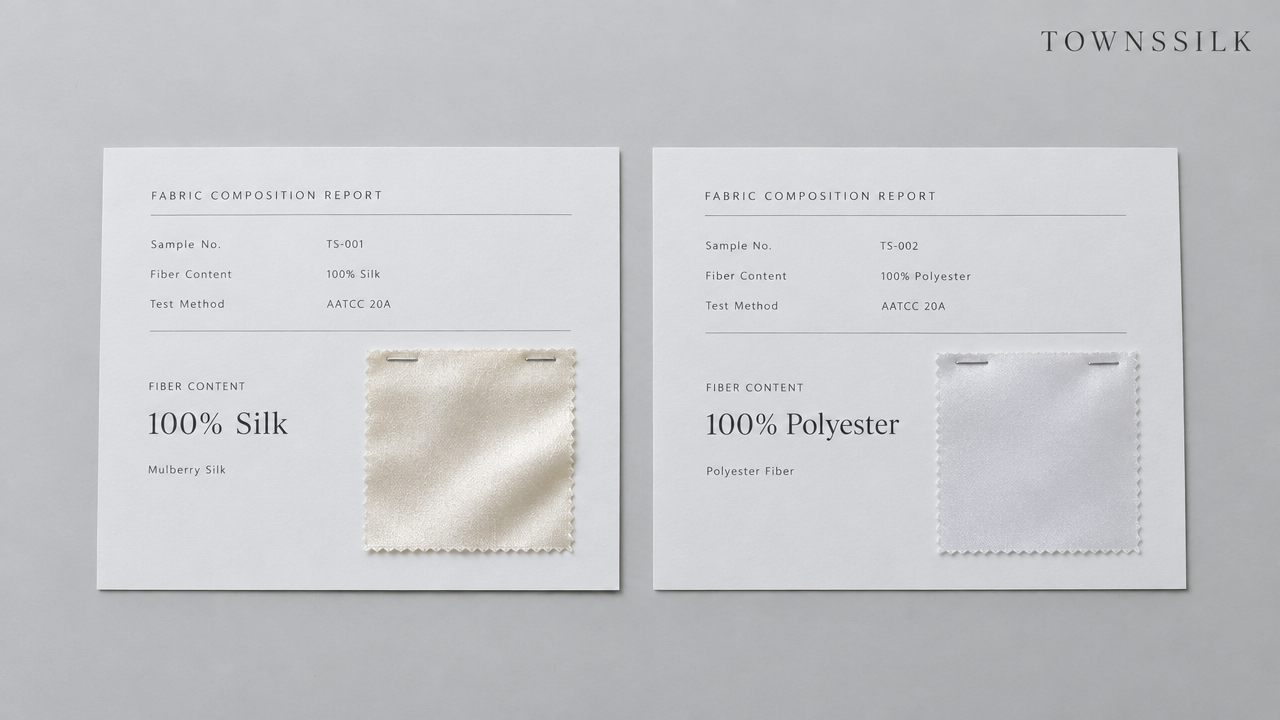
This one isn't a DIY test. It's a document your seller should already have.
If a brand claims "100% mulberry silk," they should be able to show a third-party fiber composition report. The report should reference a recognized standard:
- GB/T 2910.4 (China) — sodium hypochlorite method
- ISO 1833-4 (international) — sodium hypochlorite method
- AATCC 20A (US) — fiber composition analysis
What a lab report tells you:
- Whether the fiber is genuine silk
- The exact silk percentage in the blend
- Whether the seller's claim matches the actual product
Why it matters for you:
- The burn and bleach tests tell you whether it's silk. The lab report tells you how much.
- A lab report is the only document that holds up if you need a refund or a dispute.
If you want to go further, you can also send a sample to a third-party lab yourself. But you shouldn't have to—a brand that stands behind its silk will already have the report.
Every TOWNSSILK batch ships with a third-party lab report. If you'd like to see one before you buy, just ask.
What Real Silk Feels Like
Tests are useful. Your hands are faster.
Real silk feels:
- Soft and smooth, with a slightly waxy texture.
- Cool to the touch within the first few seconds.
- Lightweight but with a dense, luxurious drape.
- Temperature-regulating: cool in summer, warm in winter.
Fake silk feels:
- Overly slippery or unnaturally stiff.
- Warm or clammy against the skin.
- Either too light or too heavy, with no fluid drape.
Common myth: "slippery means silk." Not true. Polyester is often more slippery than real silk.
Quick test: clench the fabric in your fist, then release. Real silk should slowly recover its shape; fake silk often stays creased or springs back too fast.
FAQ
Q: What are the main differences between real silk and fake silk?
A: Real silk feels smooth, cool, and slightly waxy, with a natural shifting sheen. Fake silk feels warmer, stiffer, and has a flat, uniform gloss. In testing, real silk smells like burnt hair and dissolves in sodium hypochlorite; synthetics smell like plastic and stay intact.
Q: Can the burn test damage the silk?
A: Yes—it singes a small hidden sample. Cut from an inside seam or hem to minimize damage, and treat the burn test as a quick screen rather than a final verdict.
Q: What is "84 disinfectant," and can I use regular bleach instead?
A: "84" is a Chinese brand name for a sodium hypochlorite disinfectant. Outside China, use liquid chlorine bleach or any sodium hypochlorite solution with 5%–10% available chlorine. The active ingredient is the same.
Q: Does bleach really dissolve silk?
A: Yes. Sodium hypochlorite is alkaline and oxidizing, so it breaks down silk protein while leaving polyester and nylon intact. Weak or diluted bleach may only partially dissolve silk, so use a fresh, higher-concentration product.
Q: Is the bleach soak test as accurate as a lab test?
A: No. The bleach test is qualitative—it tells you whether silk protein is present. A lab composition test (GB/T 2910.4, ISO 1833-4, or AATCC 20A) is quantitative and tells you the exact silk percentage, which is what you need for refunds and disputes.
Q: Can I test silk before I buy?
A: Yes. TOWNSSILK sends a free fabric swatch so you can run the burn test and the bleach soak test yourself before placing an order.
Q: Which method should I use first?
A: Start with the burn test for a quick screen. If the result is unclear, move to the bleach soak test. For high-value purchases, ask for a third-party lab composition report.
Q: How do I verify silk quality before buying?
A: Ask the seller for a fiber composition report (GB/T 2910.4 or ISO 1833-4), cross-check it against a physical sample, and run the burn test or bleach soak test yourself before committing. Or contact TOWNSSILK for lab-verified mulberry silk with full documentation.
Conclusion
Before you buy, run this quick checklist:
- Does it smell like burnt hair and leave crushable ash in the burn test?
- Does it dissolve in sodium hypochlorite while polyester stays intact?
- Can the seller provide a lab composition report (GB/T 2910.4 or ISO 1833-4)?
If you answered yes to all three, you're likely holding genuine silk.
Shopping for silk you don't have to second-guess?
Every TOWNSSILK piece comes with a third-party lab report and a batch number you can verify. Request a free swatch, run the tests yourself, and see why our customers stop worrying about fake silk.
Or download our free Silk Care Guide to keep your silk looking new for years.